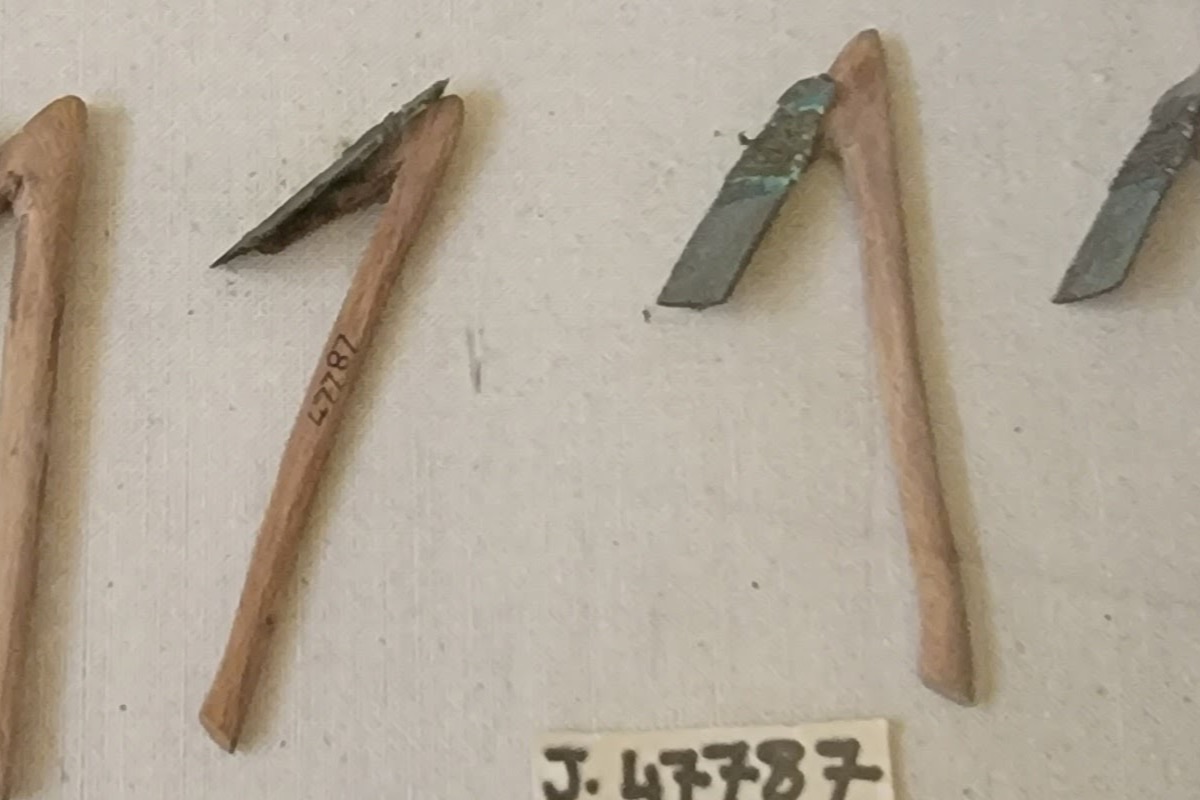
Museum labels often compress production into one material and one date. Making was a sequence: obtaining substance, preparing it, setting proportions, shaping parts, joining, finishing and correcting. Some stages remain visible because later paint has gone; others survive through unfinished areas, tool marks or technical study. Begin with the decisions a maker had to solve rather than imagining a single inspired gesture.
Break manufacture into stages
List the steps that visible construction requires. A stone vessel needs extraction, rough shaping, hollowing and polishing; a wooden chair adds cutting, joining, surface preparation and decoration. The order matters because one mistake can erase earlier labour. Museum technical panels may identify stages, while your own sequence should remain a hypothesis until supported by traces or published analysis.
Look for the working edge
Tool marks vary with material, angle and finishing. Parallel abrasion, drill holes, chisel cuts, saw traces and smoothing can show how a surface developed. Do not assign a specific tool from appearance alone when the label does not. Describe spacing, depth and direction first. A precise visible pattern is useful evidence even when its technical cause remains uncertain.
Find the joins
Composite objects distribute labour and expensive materials strategically. Search for dowels, mortises, tenons, lacing, solder, seams, inlay beds and changes in grain. A modern support can resemble an original join, so follow the museum’s conservation information. Construction often reveals an object was assembled by several specialists and perhaps designed for later disassembly, movement or repair.
Compare front, side and back
The most polished face may be only one planned view. Less visible surfaces can preserve layout lines, unfinished carving or practical attachment points. Walk around the case where permitted. Unequal finishing is not carelessness by default; it may indicate placement, budget, workflow or the point at which production stopped. Record which areas the original audience could probably see.
Treat standardization as skill
Repeated bowls, figurines, tiles or tools can result from templates, moulds, measured modules and workshop routines. Similarity does not make them mechanically or socially identical. Compare small variations in edges, colour and finishing. Repetition can reveal efficient organization while variations preserve individual gestures, material behaviour and quality control.
Ask who coordinated the work
Large or materially complex objects imply quarrying, transport, supply, design, skilled production and installation. A named patron does not replace those workers. Look for titles, workshop finds, tool models, accounts or unfinished pieces that make labour visible. Avoid inventing a modern job hierarchy; use the institutional evidence and period-specific terms actually provided.
Keep intention separate from interruption
An unfinished surface may indicate a concealed area, a planned later stage, a change of design, damage or abandonment. It does not automatically provide a frozen workshop moment. Compare the entire object, its context and similar completed pieces. State what is visibly incomplete, then list competing explanations instead of selecting the most dramatic one.
Write a production record
Draw a three-column note: visible trace, possible operation, evidence needed. Add material, scale and any label statement about technique. This structure lets observation lead while preventing a plausible reconstruction from becoming fact. After the visit, use the inventory number to look for technical catalogues or conservation reports that can confirm, revise or complicate your sequence.
Compare material economy
Look for places where expensive material is concentrated and ordinary material carries the structure. Veneer, inlay, gilding and painted imitation can produce a desired surface without making the entire object from one substance. Offcuts, repairs and recycled pieces may show another economy. Describe the material arrangement before turning it into a claim about wealth; technical analysis and archaeological workshop evidence are needed to explain supply and value.
Use an unfinished object as a control
When an unfinished piece is displayed nearby, compare the same feature across both objects: a drilled hollow, carved edge, painted ground or join. The pair can reveal sequence more securely than guessing from the completed surface alone. Confirm that the objects share material, date and relevant technique before using one as a model for the other. A useful comparison states both the resemblance and the reason it may not be exact.
Keep ancient date, modern discovery date, treatment date and visit date on separate lines. Chronology is the structure, not decoration.
Primary sources reviewed 29 July 2026: Egyptian Museum ↗ · Digital Giza ↗. Displays and visitor conditions may change.