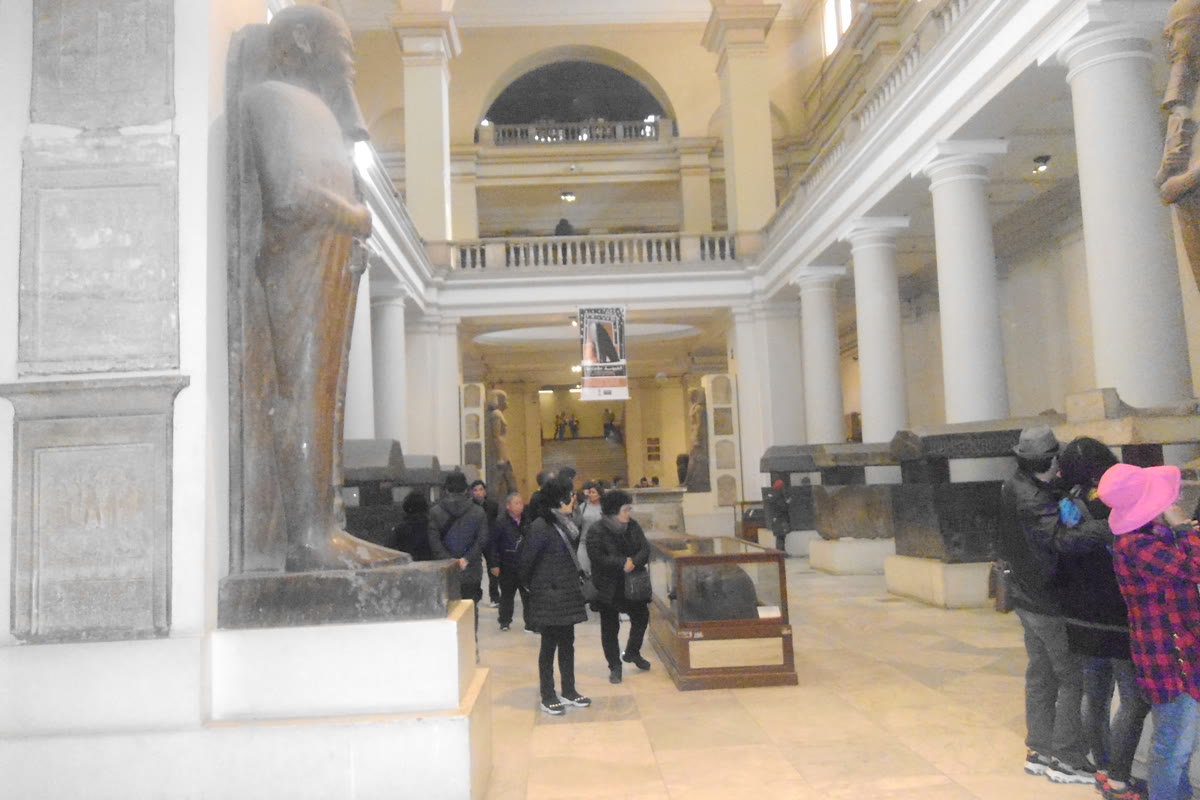
A place guide should protect attention and document relationships, not promise a fixed checklist. Use the route below with current museum information.
Begin with the museum’s timescale
The Egyptian Museum in Tahrir, the National Museum of Egyptian Civilization, the Coptic Museum and the Museum of Islamic Art organize history differently. One may foreground archaeological collecting, another a long civilization narrative, and specialised museums may concentrate material, script and religious history. Read the institutional introduction first. A different sequence is often a different mission, not a contradiction.
Use Tahrir for the discovery-to-display transition
The historic building and dense collection can make changing systems of archaeological registration and display visible. Copy inventory numbers, observe case groupings and distinguish excavation groups from comparative arrangements. The building itself belongs to Egyptian museum history. Avoid treating an older display language as if objects had no modern biography.
Use NMEC for long biographies
A civilization-scale route encourages connections across periods and materials. Follow one activity—craft, writing, clothing, food or belief—through several galleries. Long chronology can illuminate adaptation while compressing regional difference. Record where the narrative slows and where centuries pass in one transition.
Use specialised collections for reuse
At the Coptic Museum and Museum of Islamic Art, architecture, stone, wood, textile, ceramic, metal, glass and script show how forms and materials were adapted across later Egyptian histories. Do not treat these museums as appendices to a pharaonic itinerary. Apply the reuse stage carefully: distinguish physical reuse, formal inheritance and entirely new production.
Build one comparison, not four rushed visits
Choose one anchor institution per day and a second only if energy and travel allow. Museum fatigue reduces the accuracy of notes. Compare organizing principle, strongest documented transition, missing phase and one display choice after the visit. Current hours, admission and photography rules must come from official sources close to the date.
Keep Cairo outside the case
Historic Cairo and Coptic Cairo contain active worship, work and residential life. They are not outdoor galleries. Follow access and dress requirements, accept service closures and do not photograph people without consent. Museum knowledge can deepen architectural attention without turning communities into illustrations.
Close with a four-date line
For one Cairo object, record ancient date, discovery or acquisition date, any published treatment date and your observation date. If a date is missing, leave a blank. This small chronology is a more reliable comparison tool than a list of famous objects.
Compare one material across institutions
Choose wood, stone, textile, metal or ceramic and follow how each museum classifies and lights it. The same material may support archaeological chronology in one gallery and craft, religious or social history in another. Copy one object number at every stop. The exercise reveals institutional emphasis without forcing unlike collections into a ranking and produces a focused route that remains useful even when famous objects rotate.
Record travel as part of the method
Cairo distances, security procedures and traffic can consume the attention planned for a gallery. Keep the daily route conservative and confirm the exact entrance through official information close to the visit. A museum reached late should become a shorter, single-object study rather than a rushed checklist. The quality of observations matters more than the number of buildings marked complete.
Record museum, gallery, inventory number and observation date before leaving the case.
Official sources reviewed 29 July 2026: Egyptian Museum ↗ · NMEC ↗ · Coptic Museum ↗ · Museum of Islamic Art ↗. Visitor conditions may change.