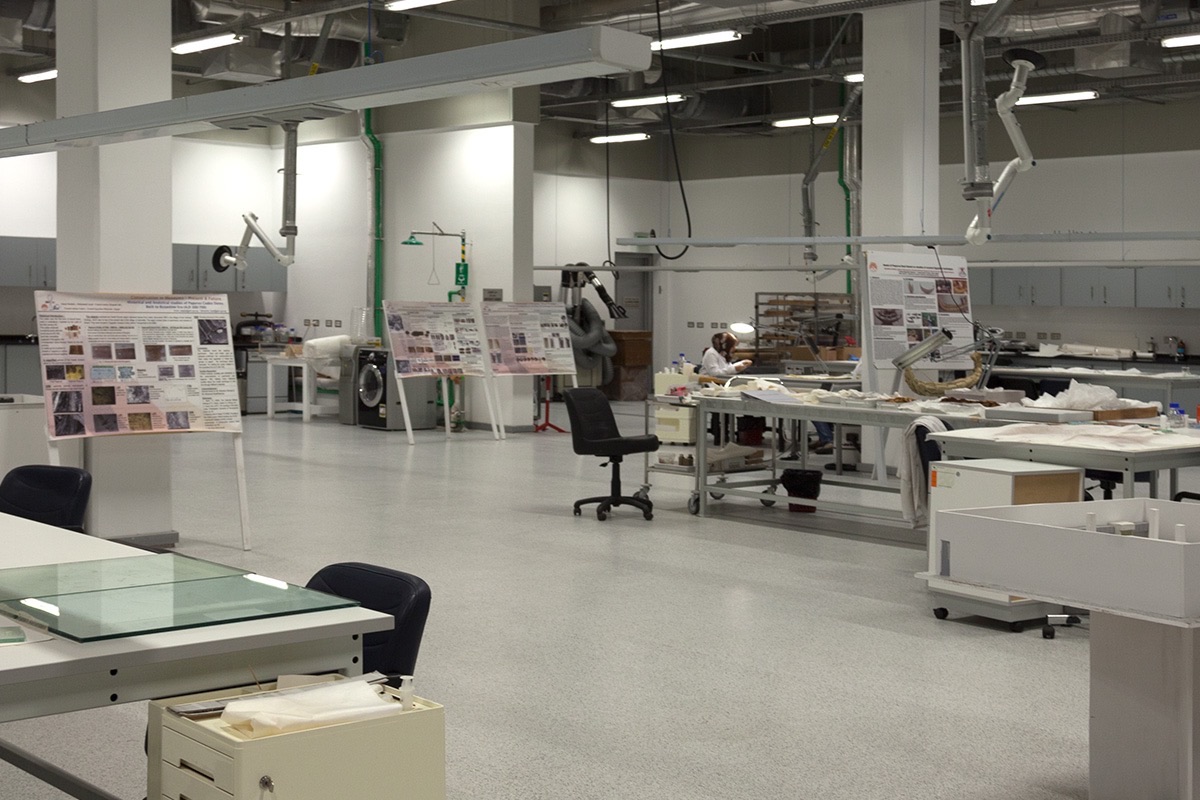
Museum objects do not become stable when excavation ends. Materials respond to humidity, light, salts, pollutants, handling and earlier treatments. Conservation combines documentation, scientific examination, practical intervention and long-term risk management. Look for its visible decisions without assuming that a complete or bright surface is the most authentic one.
Distinguish examination from treatment
Microscopy, imaging, radiography and material analysis can identify structures and condition without changing the object. Treatment may then clean, consolidate, join, support or fill. Museum panels sometimes present analytical images beside the result. Read dates and captions so the evidence from an instrument does not become confused with ordinary appearance.
Follow the condition problem
A crack, lifting paint, active corrosion or salt movement requires a specific response. Describe the location and material before reading the treatment. Conservators balance stability, evidence, appearance and future reversibility; there is rarely one automatic repair. Case climate or lower light may be the most important intervention even when visitors cannot see it.
Read fills and joins
Modern additions may be toned to reduce distraction while remaining detectable. Follow changes in texture, reflection and edge. Do not diagnose a fill solely from colour; labels and treatment diagrams are stronger. A visible join can preserve the difference between original material and reconstruction while allowing fragments to be understood together.
Notice the mount
Supports distribute weight, prevent vibration and establish orientation. They also influence how a fragment reads as a body, vessel or architectural part. Observe contact points and posture. Mount-making is both engineering and interpretation, and a new mount can change sight lines without altering the object itself.
Understand cleaning limits
Cleaning removes selected layers, not simply dirt. Corrosion, coatings, burial accretions and old restorations can carry evidence or protect fragile surfaces. Tests and documentation help define a stopping point. Avoid equating vivid colour with originality or unevenness with neglect. The treatment history should accompany any visual judgment.
Include preventive conservation
Rotation, covered cases, low illumination and restricted photography can protect sensitive textiles, manuscripts and pigments. Temporary absence may indicate responsible care, research or loan rather than a missing attraction. Current display status should be confirmed with the institution, not inferred from an old visitor photograph.
Date the intervention
Objects may contain several generations of restoration. An early plaster completion, later adhesive and recent support belong to different professional contexts. Before-and-after images rarely represent an untouched original and final truth. Record treatment dates and institutions to create a modern conservation sequence.
Make a care note
Divide a page into condition, evidence, intervention and remaining risk. Fill only what the display or official source supports, and mark your visual observations separately. This format credits conservation work while preventing a visitor from making clinical claims through glass. It also explains why care decisions can change as materials and knowledge develop.
Use imaging without mistaking it for colour
Ultraviolet, infrared, X-radiographic and computed images reveal different properties and are often assigned false colours for clarity. Read the legend and method before interpreting bright areas as original appearance. Imaging may expose joins, underdrawing, corrosion or internal structure while leaving other questions open. Pair the image with the visible object and treatment caption so a diagnostic view becomes one documented layer of evidence, not a replacement for the material.
Track movement as a conservation risk
Travel from excavation to store, laboratory, loan venue and gallery changes temperature, vibration, handling and support. Packing and condition reports therefore belong to the biography even when the object itself looks unchanged. A visitor rarely sees these records, but can note evidence of a transport mount or rotation policy. Avoid assuming that international display is routine; current loans and movements must be confirmed by the responsible institution.
Keep ancient date, modern discovery date, treatment date and visit date on separate lines. Chronology is the structure, not decoration.
Primary sources reviewed 29 July 2026: Grand Egyptian Museum ↗ · ICCROM ↗. Displays and visitor conditions may change.